Torontron
Loaded with amazing local indie games, the Torontrons are classic arcade cabinets retrofitted to play contemporary games by local game artists.
Main Gallery
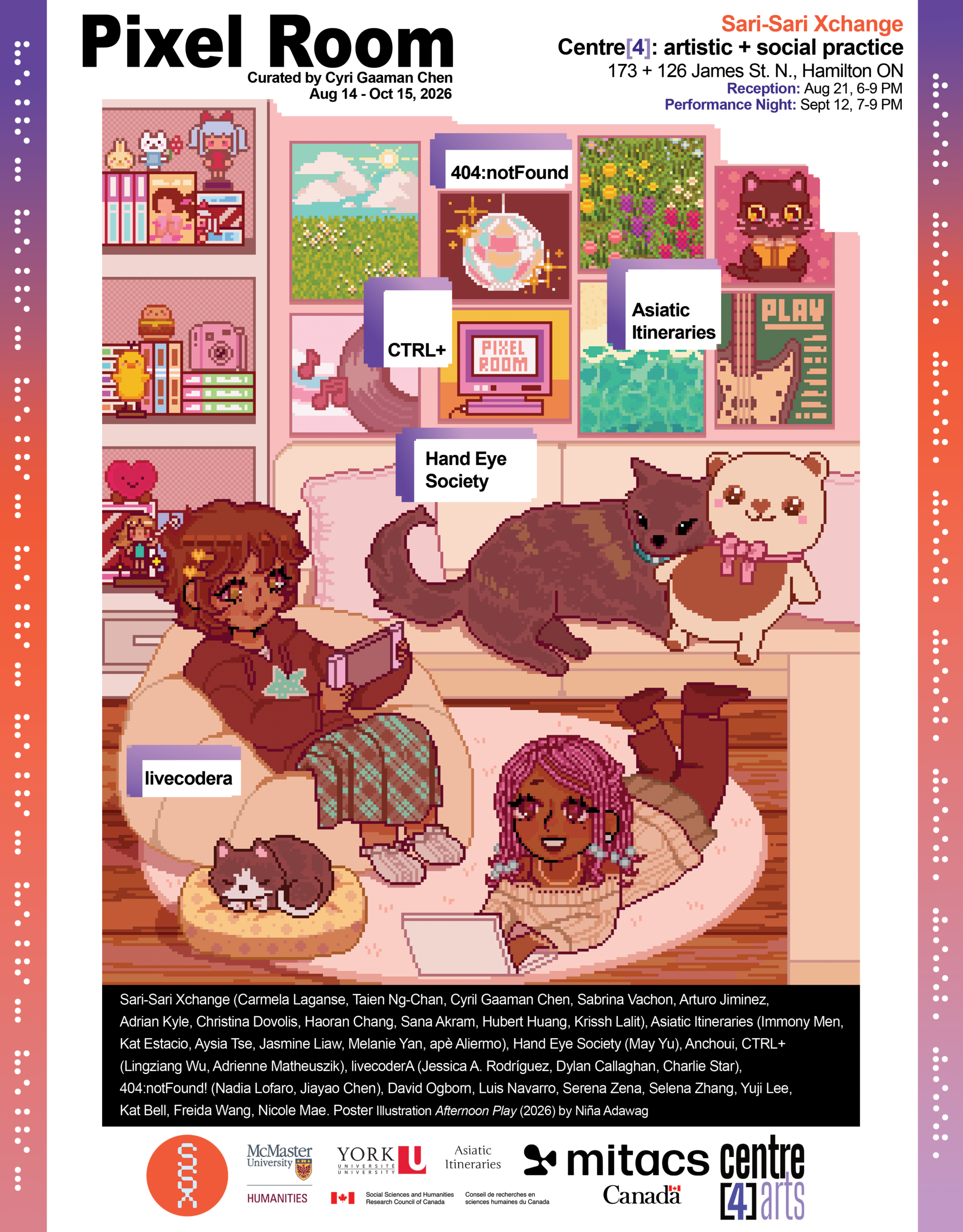
Sari-Sari Xchange, Asiatic Itineraries, livecoderA, Hand Eye Society, CTRL+, 404:notFound!, Grupo D’Binis, CurrentlyAV
Curated by Cyril Gaaman Chen
August 14th – October 15th, 2026
Opening Reception: Friday August 21st, 2026, 6:00–9:00 PM
Performance Night: Saturday September 12th, 2026, 7:00–9:00 PM
Image Credits: Courtesy of the artists.
What does it mean to care for each other in a pixelated world? What are the aesthetic and affective outputs of collectivity within worlds that are increasingly digitized? Can we allow for breaks between both modalities — the digital and the physical? Where are breaks emergent, and where have they always existed?
Featuring artists from Ontario and the prairies, Pixel Room seeks to ponder boundaries between embodiment and mixed realities, action and stillness.
Pixel Room presents a soft retrospective focusing on the past 50 years of innovations in tactile, interactive and digital media being consumed, used, and hacked with — by and for BIPOC communities. Exhibited works and sound performances highlight historic changes in visual art, sound, and digital media: from hand-made beadwork, arcade cabinets and augmented reality, to drums and dance, and live-coding.
Each medium carries its unique cultural and technological weight. Beads and thread are sewn together into a tangible actant, like pixels and binary being strung together for a digital interface. Wires are nervous systems, roots, and strings — malleable, flexible, robust, and yet still subject to breakage and ephemerality.
Pixel Room is an exhibition and performance event made in collaboration between Sari-Sari Xchange and Centre[3] for Artistic + Social Practice. The Sari-Sari Xchange is a community-building research and creation project using Extended Reality (XR) — virtual, augmented and mixed realities — to foster new works by artists from the Asian diaspora. The Sari-Sari Xchange undertakes exploration in emergent XR technologies and new storytelling techniques, to address under-representation and issues of systemic racism as well as inaccessibility of these new technologies for both creators and users with disabilities. sarisarixchange.ca
May Yu23.5″ × 17″ × 22″Electronics and wood
Loaded with amazing local indie games, the Torontrons are classic arcade cabinets retrofitted to play contemporary games by local game artists.
AnchouiGameMaker
Mowem is less a game than it is a toy. In lieu of a goal or purpose, players decide what a toy ought to be used for. At its core, Mowem is built around the idea that toys react to interaction, thereby inventing its own purpose.
Serena Zena25cm × 15cm × 10cmBasswood, UV resin
In Lifeform, Zena employs hand wood carving in combination with cutting edge UV resin technology. The work is constructed through a process of 3D scanning ancient trees in Scotland’s Loch Lomond, and re-interpreting the scans through sculpture as a form of digital abstraction. Natural resin is produced from trees, which then hardens and becomes amber responsible for preserving many ancient species. In Lifeform, the hardened resin is entirely synthetic and dependent on human technology. The piece contemplates human intervention within our planet’s existing ecology and natural systems.
Selena Zhang11.5cm × 3.5cmHeat-fused perler beads
This Nüshu piece renders the phrase “大雨往下,女子向上” in perler beads, meaning “rain falls downward, while women move upward.” Nüshu, a women’s script and Chinese intangible cultural heritage, carries histories of women’s expression beyond formal education and literacy. Through beadwork, the work preserves feminist memory, community resistance, and women’s movement against erasure and silence.
Yuji Szero Lee13″ × 6″Mixed media (perler beads, plastic beads, nylon cord, nylon tassel)
Combining perler bead pixel art with Chinese knotwork elements, rabbit4rabbit merges digital aesthetics with traditional craft and rejects the notion of queer Asian diasporic identity as contradictory or a recent phenomenon.
Niña Adawag271px × 319pxDigital media, iPad Air and Clip Studio Paint
My illustration encapsulates the aspects of fun, coziness, and comfort to pixel games. I was inspired by my own feelings playing games, such as Harvest Moon, Kirby Super Star Ultra, and Cooking Mama on the DS.
Haoran Chang122″ × 260″Interactive game
In this meditative play experience, players practice Zhan Zhuang, a standing meditation rooted in Daoist tradition, to reconnect with the cosmos through their relationship with a growing tree. Through cultivating alongside the tree, players can discover their resonant trees within a shared virtual nature environment, collectively shaped by individual participants.
Cyril Chen for Centre[4]: Artistic + Social Practice31″ × 19.5″Godot Engine, HTML5, itch.io, Blender, Polycam, Autodesk Fusion — on Centre[4] touchscreen display
As an ongoing research project, Cyril is developing an online interactive space of the Centre[4] traditional studio with accessible features and information mapping. This project is made in consultation with Centre[4]’s Executive Director Yvonne Felix. — Beacon Project
CTRL+: Adrienne Matheuszik and Lingxiang Wu9cm × 6cm × 18cmAcrylic, PLA filament, plastic capsules, stickers, AR, web-based game
Didi (Digital Deity) is an AR artwork rooted in a fabricated avatar and a small sculptural “shrine” in the form of a gacha machine. The project begins with a simple question: what if the cyborg is not an extension of ourselves, but a manifestation of digital systems that train our bodies through repetition, reward, and maintenance? We draw on the familiar language of toys — Tamagotchi, blind boxes, and collectible vinyl figures — to make this mythical presence legible.
Christina Dovolis100″ × 80″Interactive installation
SLIT-SCAN-CAN-CAN is an interactive slit-scan projection that uses a webcam and live coding to continuously “scan” bodies in real time. As visitors move through the camera’s field of view, their gestures are stretched across the projection, creating time-based tableaus that unfold across the wall. The work explores the relationship between body and landscape, asking how something as intimate as human movement can generate vast, horizon-like terrains.
Sari-Sari Xchange & Asiatic Itineraries100″ × 80″MP4 projection
Looking In is a composite of animated rooms designed by various artists. Each artist interprets their own idea of “home” through the act of gazing into spaces inhabited by bodies, histories, memories, relations, and presences — tangible, imagined, ephemeral, and of the in-betweens.
Independent artists will be selling their micropress copies and hand-made works in person on August 21, and during the Supercrawl weekend from September 11–13.
Melanie YanDigital illustration, text, zine
Let’s Run Far Far Away is a flat zine that talks about fragility and vulnerability in love. Printed in risograph.
Nicole MaeFreeform poetry and blackout poetry
Ribgrass is an atmospheric and haunting poetry collection. It explores the decay and resurrection of trans-queerness in the prairies. From farmland nostalgia to soft romances, Ribgrass is a vehicle for grief. The cyclical nature of mourning finds you everywhere — in an algae lake, in the kitchen fridge, in your hospital bed. It shows up as bugs in your bones.
Frieda WangPhotography, poetry collage, zine
have a seat documents and ruminates on abandoned chairs throughout various cities in states of disrepair. Lonely objects with lives fully lived — all too personified and melancholic. Consisting of a selection of photographs over the years throughout the cities of Toronto, Edmonton and Vancouver, these chairs are paired with contemplative writing in a book that, if we’re honest, is not really about chairs at all.
Kat BellCollage and text, zine
Queerness and punk have a long interconnected history. This zine is a collection of a few of my personal favourite queer punk albums.
Olivia Mae SinclairTextile, text, imagery, zine
These books combine handmade textiles, text, and imagery to explore mental health, trauma, and the messy realities of being human. Drawing from personal experience, I create tactile works that invite conversation, challenge stigma, and remind viewers that they are not alone.
173 James Street North · Doors open 5:30pm
126 James Street North · Doors open 6:30pm
Adrian Kyle, Adrienne Matheuszik, Anchoui, apè Aliermo, Arturo Jimenez, Aysia Tse, Carmela Laganse, Charlie Star, Christina Dovolis, David Ogborn, Dylan Callaghan, Freida Wang, Haoran Chang, Hubert Huang, Immony Men, Jasmine Liaw, Jessica A. Rodríguez, Jiayao Chen, Kat Bell, Kat Estacio, Krissh Lalit, Lingziang Wu, Luis Navarro, May Yu, Melanie Yan, Nadia Lofaro, Nicole Mae, Niña Adawag, Olivia Mae Sinclair, Rain/griefrot, Sabrina Vachon, Sana Akram, Selena Zhang, Serena Zena, Taien Ng-Chan, Yuji Lee
Haoran Chang is a visual artist, media art researcher, and experimental game designer. His practice and research focus on game studies, immersive media, and art in cosmotechnics.
Selena Zhang is an MA student in Gender and Social Justice at McMaster University. Her research interests include Chinese feminism, East Asian queer studies, and transnational feminism.
Niña Adawag is an enthusiastic Filipina artist for all cute and cat things. She loves creating pixel art, especially illustrating concepts of cozy pixel games and sweet treats.
Cyril Gaaman Chen (they/them) is a media artist, animator and percussionist/drummer based in Hamilton, ON and Regina, SK, exploring queer and diasporic multimedia production and design. Cyril is a research assistant for Sari-Sari Xchange and a PhD student in Communications, New Media and Cultural Studies at McMaster University.